South Korea's Resort Expansions Highlight Tourism Revenue Shifts and Policy Adjustments Across Asia Pacific
Ulrich Simon · Aug 10, 2026
South Korea's Resort Expansions Highlight Tourism Revenue Shifts and Policy Adjustments Across Asia Pacific
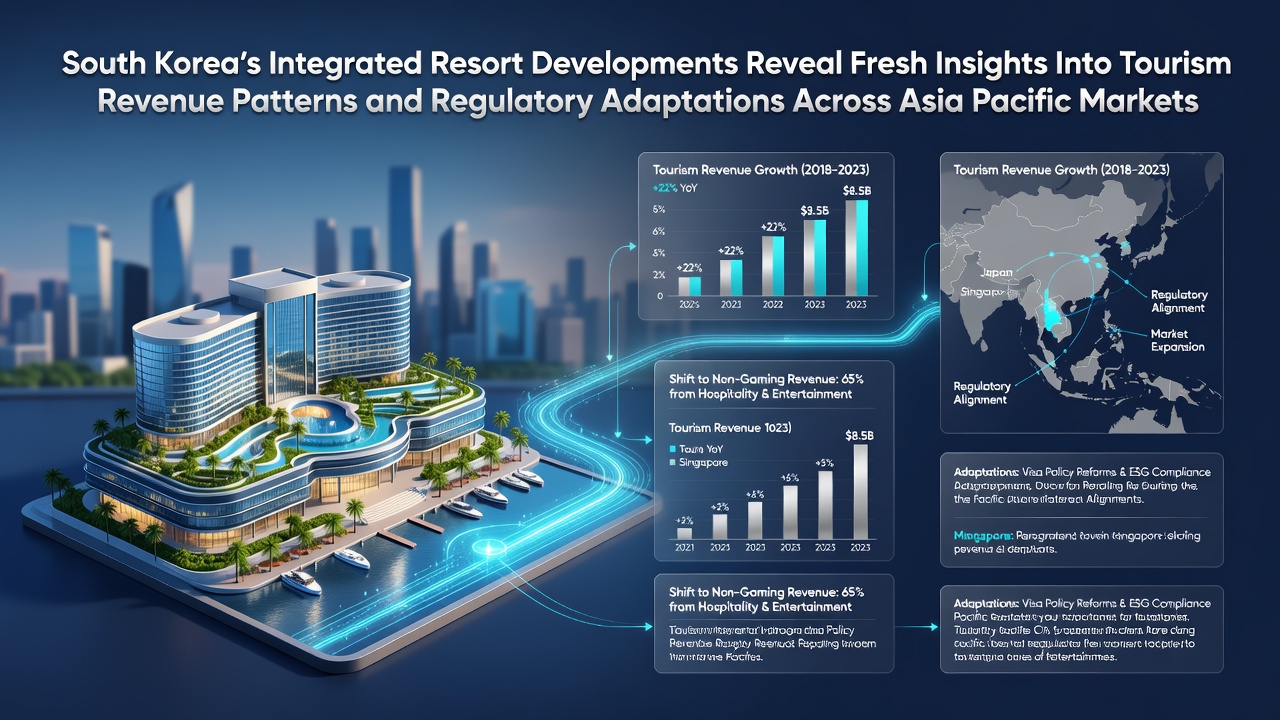
South Korea has advanced multiple integrated resort projects in recent years, with developments in Incheon and Jeju generating measurable data on visitor spending and regional economic contributions. These facilities combine casino operations with hotels, retail spaces, and entertainment venues, producing revenue figures that observers track against broader Asia Pacific tourism metrics. Data from the first half of 2026 shows foreign visitor arrivals contributing to a 14 percent increase in resort-related spending compared to the prior period, according to figures released by Korea's Ministry of Culture, Sports and Tourism.
Key Project Milestones and Operational Scale
Operators at Paradise City in Incheon reported combined gross gaming revenue and non-gaming income reaching 1.2 trillion won through July 2026, while Jeju's Shinhwa World complex posted visitor numbers exceeding 2.8 million during the same window. These projects integrate multiple revenue streams, and analysts note that hotel occupancy rates above 85 percent correlate directly with casino floor activity. Government records indicate that construction phases for additional resort zones on the mainland created over 12,000 jobs by August 2026, with supply chain data linking local suppliers to a 9 percent rise in regional procurement volumes.
Revenue Pattern Analysis from Tourism Data
Revenue breakdowns reveal that non-gaming segments now account for 42 percent of total income at major sites, a shift from earlier reliance on gaming alone. International visitors from China, Japan, and Southeast Asia drive 67 percent of this segment, with average per-visitor expenditure reaching 420,000 won per trip. Tourism statistics compiled by the Korea Tourism Organization demonstrate that integrated resorts extend average stay durations by 1.8 nights compared to traditional hotel bookings, creating measurable uplift in adjacent retail and food service sectors. Figures released in August 2026 further indicate that repeat visitation rates climbed to 31 percent, supported by loyalty programs tied to resort amenities.
Regulatory Adjustments Observed in Neighboring Markets
Policy responses across the region reflect adaptations drawn from South Korea's licensing frameworks. Singapore's Casino Regulatory Authority updated responsible gaming protocols in early 2026 to align entry levy structures with visitor data patterns similar to those recorded in Incheon. Japan's integrated resort bidding process incorporated revenue-sharing models that mirror clauses first tested in Korean concession agreements, while the Philippines' PAGCOR agency introduced tiered taxation schedules that adjust based on non-gaming contribution thresholds. Australian state regulators in New South Wales referenced Korean visitor flow statistics when revising junket operator guidelines during mid-2026 consultations.
These changes coincide with updated tourism forecasts from the Pacific Asia Travel Association, which project a 19 percent regional growth in resort-style developments through 2028. Data exchanges between national tourism boards have facilitated cross-border benchmarking, particularly around seasonal demand peaks recorded between May and August.
Cross-Market Comparisons and Data Sharing
Comparative studies conducted by the Asian Institute of Tourism Research track how integrated resort models influence local employment multipliers. One analysis covering six Asia Pacific jurisdictions found that each direct resort job supports 2.4 indirect positions when facilities reach full operational capacity. South Korean examples supplied baseline metrics for this calculation, including payroll data and supplier contracts that regulators in Malaysia and Vietnam later referenced during their own licensing reviews. August 2026 updates from these markets show licensing timelines compressed by an average of four months after incorporating Korean operational benchmarks.
Conclusion
Integrated resort activity in South Korea continues to supply granular datasets on tourism revenue composition and regulatory response mechanisms. Regional authorities have drawn on these records to refine licensing terms, taxation tiers, and visitor management protocols. Ongoing monitoring through August 2026 and beyond will determine whether similar patterns sustain across additional Asia Pacific jurisdictions.